
Public agencies across southern California have spent hundreds of millions of dollars on structural stormwater control measures – and are planning to spend hundreds of millions more to manage runoff water quality and quantity.
To ensure stormwater BMPs (best management practices) are performing to their full potential, public agencies need field data reflecting how BMPs actually perform under environmental and operating conditions found in southern California.
The SMC has begun working to fill this key data gap through its Regional BMP Monitoring Network. Using the program’s first three years of wet-weather field monitoring, researchers have been generating foundational insights on BMP performance, both to help improve existing BMPs that aren’t performing to their full potential, and to help improve design and construction guidance for future BMPs being planned.
During an all-day SMC workshop in March 2026 that attracted more than 130 attendees, the SMC reviewed monitoring data collected to date and agreed that the monitoring network is ready to be leveraged to answer focused, high-priority management questions related to BMP performance.
The SMC is in the process of developing monitoring studies that will isolate causes or characteristics of individual biofilter BMPs with exceptionally strong vs. poor performance, with a goal to refine design guidance for biofilters that have yet to be built. The SMC also is exploring how to leverage the BMP network to identify effective retrofit options and/or alternative designs to improve treatment performance for bacteria, nitrogen and other priority pollutants.
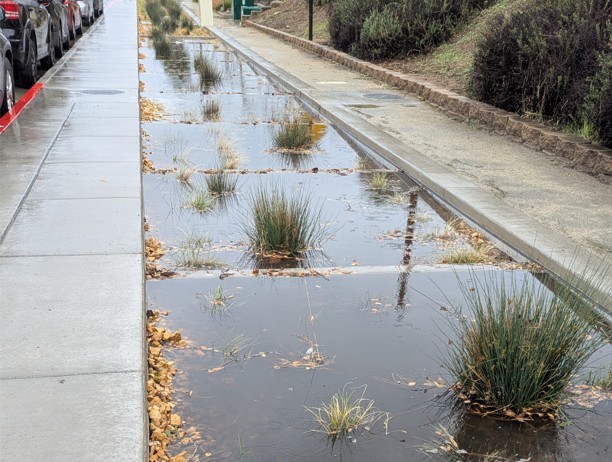
The SMC began building the Regional BMP Monitoring Network in 2020 to generate high-quality, comparable data sets on the performance of bioretention systems, infiltration galleries and other types of structural BMPs across Southern California. BMPs can perform very differently in Southern California than in other, wetter parts of the U.S., underscoring the need to collect locally relevant performance data.
Although Southern California has implemented hundreds of structural BMPs over the past three decades, the region has historically lacked robust data sets to comprehensively explain the factors and conditions that disproportionately influence how these systems perform – or underperform – and how this performance can change over time.
The SMC Regional BMP Monitoring Network provides regionally representative, directly comparable data sets encompassing monitoring data from 13 individual biofilter BMPs and more than 100 storm events.
The SMC already has begun exploring how to evolve monitoring over time, including possibly scaling back longitudinal monitoring to focus resources on targeted studies.
SMC member agencies also are individually pursuing monitoring studies that leverage the BMP network. For example, San Diego County has begun working with SCCWRP (Southern California Coastal Water Research Project) to investigate the conditions that affect BMP effectiveness in removing fecal indicator bacteria (FIB) in wet weather runoff.
Meanwhile, the network’s data already have helped the SMC to pinpoint which performance metrics are particularly relevant for assessing BMP performance, and to develop a suite of performance assessment tools that have been integrated into a web-based open data portal.
A technical report summarizing the workshop discussions and recommendations is expected to be published later this year.
For more information, please contact Dr. Elizabeth Fassman-Beck at SCCWRP.
Dive deeper
- How the new SMC data analysis tools are helping stormwater managers evaluate BMP performance
- A data-driven index for evaluating BMP water quality performance (Journal manuscript)
- Rainfall and Flow Analysis Calculator and Flow-Weighting and EMC Calculator to streamline BMP performance analyses for individual storm events
- Development of the SMC Regional BMP Monitoring Network (PDF)
- SMC Regional BMP Monitoring Network Work Plan (PDF)
SMC Summer 2026 Newsletter
Volume 7, Issue 1
This newsletter is published three times a year by the Southern California Stormwater Monitoring Coalition (SMC). To subscribe to this newsletter, contact inquiries@socalsmc.org.