
Across urbanized Southern California, hundreds of miles of streams have been modified to contain storm flows and help protect human life and property from flooding.
These streams – sometimes referred to as engineered channels – are characterized by modifications to channel shape and/or hardening of their banks and/or bottom. And they typically receive lower biological integrity scores than their more natural counterparts.
Channel modifications can degrade habitats for organisms, disrupt natural hydrologic and sediment regimes, increase thermal stress, and increase susceptibility to eutrophication. Meanwhile, these challenges are commonly accompanied by ongoing removal of sediment and vegetation as part of channel routine maintenance.
The challenge for stormwater managers is understanding how to balance managing the biological health of engineered channels with the need to preserve their flood control functions: Can biological health be improved by addressing water chemistry stressors and/or reducing flow alterations, while leaving channel modifications in place? Are there sites that could benefit from physical habitat improvements or changes to routine maintenance regimes that could mitigate or partially reverse the effects of channel modifications – but without compromising flood control functions?
To provide insights into these questions, managers rely on science – specifically, investigations that tease apart the relative effectiveness of multiple potential management options that, either alone or in combination, could be implemented to improve stream biological health in engineered channels.
For the past decade, the SMC has been a regional leader in collaboratively building a technical foundation for Southern California watershed managers to make science-informed decisions for protecting stream biological health that do not compromise their flood-control functions.
In 2025, the SMC completed a three-year study (SMC Project 5.3: Improving Biointegrity in Engineered Channels) that evaluated whether variability in water chemistry or flow patterns is associated with stream biological health in engineered channels, as a strong association would suggest that improving water chemistry could benefit biological health even if modifications remain in place. Subsequently, the SMC launched a three-year follow-up study (SMC Project 2.1: Meeting Biological Expectations in Urban Streams) to investigate these issues in more depth, as well as to evaluate whether projects that focus on improving physical habitat could also move the needle on biological health.
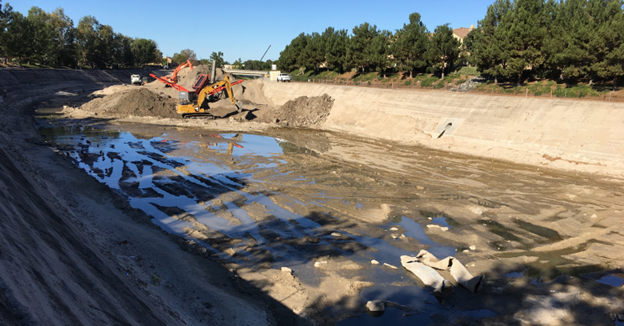
Collectively, these regional research investments will help watershed managers understand how to protect and improve biological health in engineered channels without compromising their flood control functions. With this information, SMC member agencies hope to identify engineered channels where specific management actions are likely to be more effective in improving biological health, as well as to help managers prioritize which actions to implement and where to deploy them.
To date, the SMC has focused on investigating the effectiveness of three potential management strategies for addressing poor stream biology: improving water chemistry, changing flow patterns to a less altered state, and improving physical habitat.
The SMC’s engineered channels research will support California watershed managers as they seek effective options for managing stream biological health.
Biology-based approaches to stream monitoring are now used in multiple streams across California to set management goals, and stream biological assessment scores get reported in the California Integrated Report summarizing the condition of surface water quality statewide. In 2020, the San Diego Regional Water Quality Control Board developed a stream water-quality objective that calls for the use of bioassessment tools to score the health of perennially and intermittently flowing streams across the San Diego region. If approved, the objective – which is undergoing review by the State Water Resources Control Board and has not yet taken effect – would apply to natural and soft-bottom engineered channels with soft or natural stream beds; it would exclude channels with “fully hardened” stream beds that have been lined with materials such as concrete and grouted rock.
The San Diego Regional Board’s decision to exclude streams with fully hardened channels but include streams with soft-bottom channels was based in part on research conducted by the SMC – a body of work that is summarized in the first Dive Deeper article below.
Dive deeper
- What the SMC has learned so far about options for improving stream biology in engineered channels
- SMC full 2025 report on improving biointegrity in engineered channels (PDF; SMC Project 5.3)
- SCCWRP 2025 report: A Technical Foundation for Biointegrity and Eutrophication Indicators and Thresholds for Modified Channels, Intermittent Streams, and Streams on the Central Valley Floor (PDF)
SMC Spring 2026 Newsletter
Volume 6, Issue 2
This newsletter is published three times a year by the Southern California Stormwater Monitoring Coalition (SMC). To subscribe to this newsletter, contact inquiries@socalsmc.org.