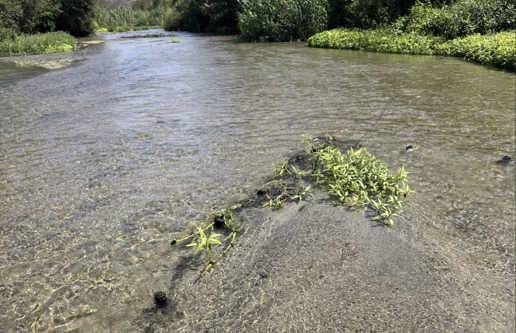
The biological condition of streams across California is measured using quantitative bioassessment scoring tools – namely, the California Stream Condition Index (CSCI) and the Algal Stream Condition Index (ASCI) – that measure the health of specific types of aquatic life living in these streams. The CSCI focuses on benthic macroinvertebrates, while the ASCI focuses on algae.
When these scoring tools have been applied to streams in Southern California, engineered channels more often received lower index scores compared to their more natural counterparts.
To sustain and improve biological conditions in these streams, Southern California watershed managers are exploring the potential effectiveness of three common classes of interventions: Improve water chemistry, reduce alterations to flow patterns, and improve physical stream habitat. The SMC has been investigating all three options; the SMC’s efforts to date to improve understanding of each option are summarized below.
The SMC’s long-term goal is to establish a framework that enables Southern California watershed managers to identify which engineered channels are most vs. least likely to benefit from different types of interventions, so managers can prioritize focusing on the sites that show the most promise.
Addressing water chemistry
In summer 2025, the SMC completed a comprehensive analysis of bioassessment data that found that while CSCI scores in Southern California streams as a whole are higher when water chemistry parameters are good, this relationship is weaker for engineered channels, particularly hard-bottom channels. This study found only about 8% of soft bottom channels, and only a single hard-bottom channel (out of more than 200 sites), had CSCI scores above 0.79, which is the threshold for natural reference-like conditions. The study evaluated four stressors (eutrophication, salinization, habitat degradation, temperature alteration) and found that about two-thirds of streams in engineered channels could see improved bioassessment scores through stressor reduction, even if channel engineering features remain in place. This relationship was weakest for streams in hard-bottom channels, suggesting that these streams might be least likely to benefit from chemical stressor reduction alone; however, because most hard-bottom channels co-occur with extensive development within the watershed, researchers could not say whether constructed features alone substantially affect stream biological health (i.e., independent of the associated effects of poor water quality and flow alteration).
The 2025 findings build on prior SMC research, including an initial 2015 SMC analysis of bioassessment data that found that engineered channels had almost uniformly poor CSCI scores, and they did not show as strong of a relationship with water quality gradients observed in unmodified streams. This study concluded that some streams in engineered channels with soft-bottom beds could have more potential to see their ecological condition improved through management of both water chemistry and physical habitat.
A follow-up 2017 SMC study that completed a similar analysis using ASCI scores found that although the ASCI scores were also lower in engineered channels, algal communities are far more likely than benthic macroinvertebrates to exhibit natural levels of biodiversity in streams with hard-bottom channels. In fact, ASCI scores were somewhat better in engineered channels with hard bottoms than in engineered channels with soft bottoms. The study hypothesized that algae were less sensitive to physical habitat alteration compared to benthic macroinvertebrates, and thus they may be better able to reflect water quality gradients in hard-bottom channels. Thus, using the two indices together provides a more complete picture of stream biological health.
Reducing alterations to flow patterns
Most engineered channels were modified to mitigate the risks of flooding during peak flow periods. But these modifications can lead to multiple other types of changes in flow patterns, including reducing or eliminating base flows, changing the rate of flow recessions, and even converting an ephemeral stream to a perennial one. These flow alterations, which are a known cause of poor biological conditions in unmodified streams, may contribute to poor biology in streams in engineered channels as well. Thus, reducing flow alteration has the potential to reduce stress and improve stream biological health.
During the three-year SMC study completed in summer 2025, researchers found that making even relatively small-scale changes to shift flow patterns to a less altered state has the potential to result in higher bioassessment scores. Importantly, the two flow components that are most critical to the health of stream biological communities – dry-season baseflow and fall pulse magnitude – were more frequently and severely altered in engineered channels compared to natural channels, meaning that these flow components were identified by the study as the most important to adjust to achieve improved bioassessment scores.
Even so, the study also found that while modest changes in flow patterns can yield improvement to bioassessment scores in many engineered channels, even substantial changes in flow patterns alone, especially in hardened streams, may not raise scores enough to meet the San Diego Regional Board’s proposed water quality objective, which calls for CSCI scores at or above 0.79; the study found that only a small percentage of sites achieved reference conditions with only small changes to flow patterns. Thus, an approach that focuses on creating more natural flows alone while neglecting other stressors is unlikely to be effective for many streams; simultaneous changes to water chemistry or physical habitat may also be needed.
Improving physical habitat in streams
Improving physical stream habitat in engineered channels can be a complex undertaking, as the primary purpose of most channel modifications is to contain storm flows and provide flood protection. Thus, removal of channel hardening features and moving levees that result in increased risks to public safety are not considered viable options at this time. The SMC study that was launched in summer 2025 is evaluating if other strategies – including adding native riparian vegetation and other in-stream habitat, creating naturalistic side channels, and re-creating natural channel forms – can improve stream biological health without compromising flood-control functions. If one or more of these strategies is viable, the SMC will investigate what types of settings might be good candidates. This study is expected to wrap up in 2028.